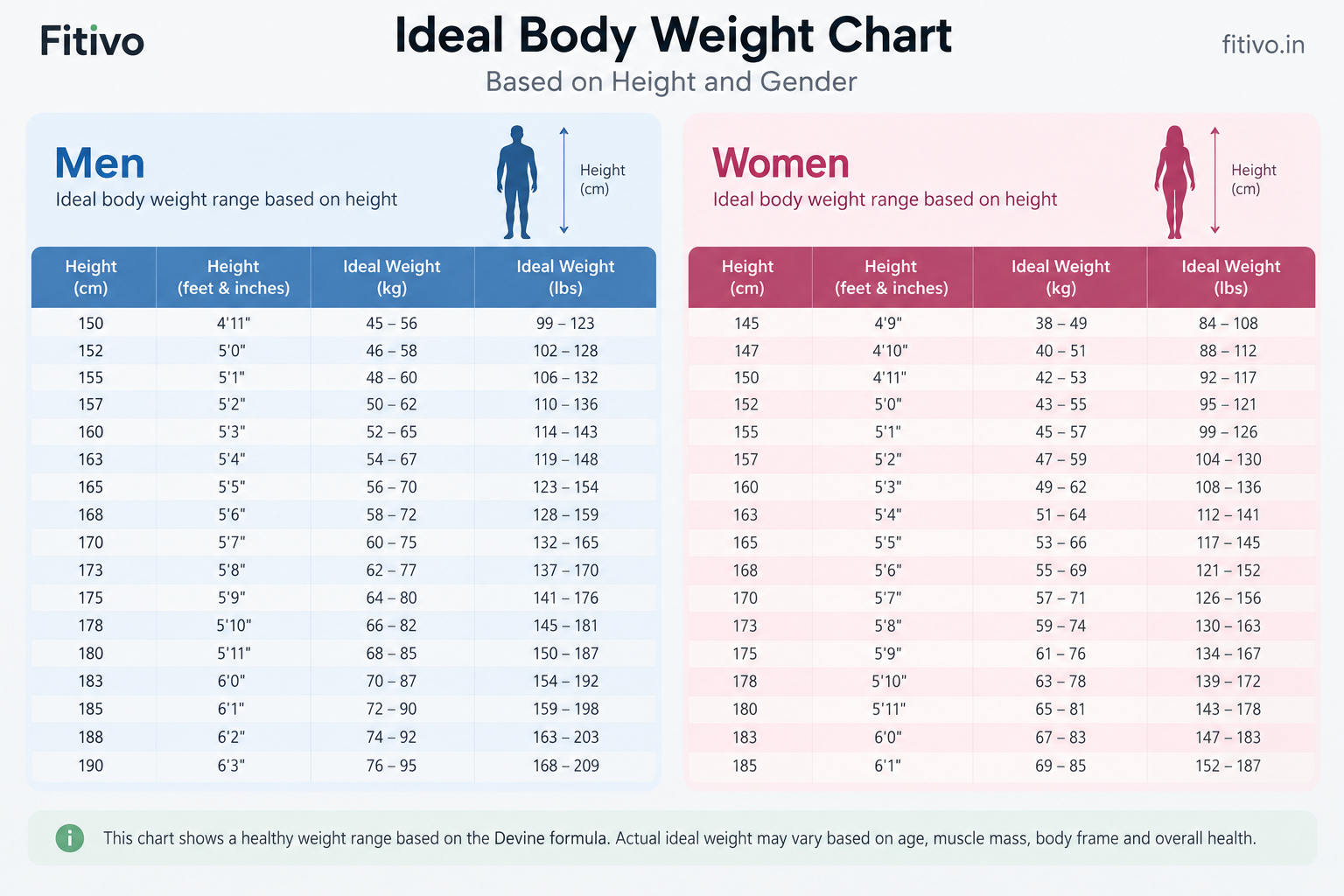
What is the Formula for Ideal Body Weight?
The clinical formula for ideal body weight provides an evidence-based guideline for calculating optimal human body weight relative to skeletal stature. Most clinical equations assign a baseline weight for an adult standing 5 feet tall (60 inches / 152.4 cm) and add an incremental weight coefficient for every additional inch of height.
The 4 Clinical Formulas for Ideal Body Weight (Height > 5 ft):
1. Devine Formula (1974) — Clinical Gold Standard:
• Men: 50.0 kg + 2.3 kg × (height in inches - 60)
• Women: 45.5 kg + 2.3 kg × (height in inches - 60)
2. Robinson Formula (1983):
• Men: 52.0 kg + 1.9 kg × (height in inches - 60)
• Women: 49.0 kg + 1.7 kg × (height in inches - 60)
3. Miller Formula (1983):
• Men: 56.2 kg + 1.41 kg × (height in inches - 60)
• Women: 53.1 kg + 1.36 kg × (height in inches - 60)
4. Hamwi Formula (1964):
• Men: 48.0 kg + 2.7 kg × (height in inches - 60)
• Women: 45.5 kg + 2.2 kg × (height in inches - 60)
Ideal Body Weight Reference Table (Men & Women by Height)
Use this clinical reference table to quickly look up baseline target weights and healthy South Asian BMI weight brackets (18.5 – 22.9 kg/m²) for common adult heights.
| Height (ft / cm) | Men (Devine) | Women (Devine) | Robinson Consensus | Healthy South Asian Range |
|---|---|---|---|---|
| 5'0" (152 cm) | 50.0 kg | 45.5 kg | 49.0 – 52.0 kg | 42.7 – 52.9 kg |
| 5'2" (157 cm) | 54.6 kg | 50.1 kg | 52.4 – 55.8 kg | 45.6 – 56.4 kg |
| 5'4" (163 cm) | 59.2 kg | 54.7 kg | 55.8 – 59.6 kg | 49.2 – 60.8 kg |
| 5'6" (168 cm) | 63.8 kg | 59.3 kg | 59.2 – 63.4 kg | 52.2 – 64.6 kg |
| 5'7" (170 cm) | 66.1 kg | 61.6 kg | 60.9 – 65.3 kg | 53.5 – 66.2 kg |
| 5'8" (173 cm) | 68.4 kg | 63.9 kg | 62.6 – 67.2 kg | 55.4 – 68.5 kg |
| 5'10" (178 cm) | 73.0 kg | 68.5 kg | 66.0 – 71.0 kg | 58.6 – 72.6 kg |
| 6'0" (183 cm) | 77.6 kg | 73.1 kg | 69.4 – 74.8 kg | 62.0 – 76.7 kg |
How to Interpret Ideal Body Weight vs. Real Body Composition
While the formula for ideal body weight serves as a helpful reference point for medical dosing and broad health guidelines, it does not distinguish between skeletal muscle, bone density, and visceral fat.
If your current body weight is higher than your calculated IBW, evaluating your body fat percentage with our tape-measurement tool or reviewing your South Asian BMI range (18.5 – 22.9 kg/m²) provides crucial context on whether that weight is healthy muscular tissue or excess adiposity.
Frequently Asked Questions
What is the clinical formula for ideal body weight?
The most common clinical formula for ideal body weight is the Devine Formula (1974). For adult men: 50.0 kg + 2.3 kg for every inch over 5 feet tall. For adult women: 45.5 kg + 2.3 kg for every inch over 5 feet tall. Other peer-reviewed equations include Robinson (1983), Miller (1983), and Hamwi (1964).
Why does ideal body weight differ from your current body weight?
Ideal Body Weight (IBW) provides a theoretical target weight derived strictly from height and biological gender. It does not measure individual muscularity, bone frame density, or subcutaneous fat distribution. An athletic individual with high muscle mass may weigh more than their IBW while remaining exceptionally healthy and lean.
Which formula for ideal body weight is the most accurate?
The Devine formula is universally recognized as the clinical benchmark across pharmacology and medical care. However, modern clinicians often look at the consensus average of Devine, Robinson, and Miller alongside healthy BMI ranges (18.5 to 22.9 for South Asian populations) for a comprehensive picture.
How does ideal body weight relate to South Asian healthy weight guidelines?
Because South Asian populations tend to carry higher visceral adiposity at lower body weights, WHO and ICMR guidelines suggest a normal BMI cutoff of 18.5 to 22.9 kg/m². Our calculator displays both your clinical IBW formulas and your healthy South Asian BMI weight bracket.