What is TDEE and How to Calculate It
Understanding Total Energy Expenditure, Total Daily Energy Intake, and Calorie Balance
Your Total Daily Energy Expenditure (TDEE) represents the aggregate number of calories your body burns over 24 hours. Knowing your TDEE is the cornerstone of effective body recomposition: it establishes your maintenance baseline, allowing you to match your total daily energy intake to maintain your weight, or adjust it to lose or gain weight predictably.
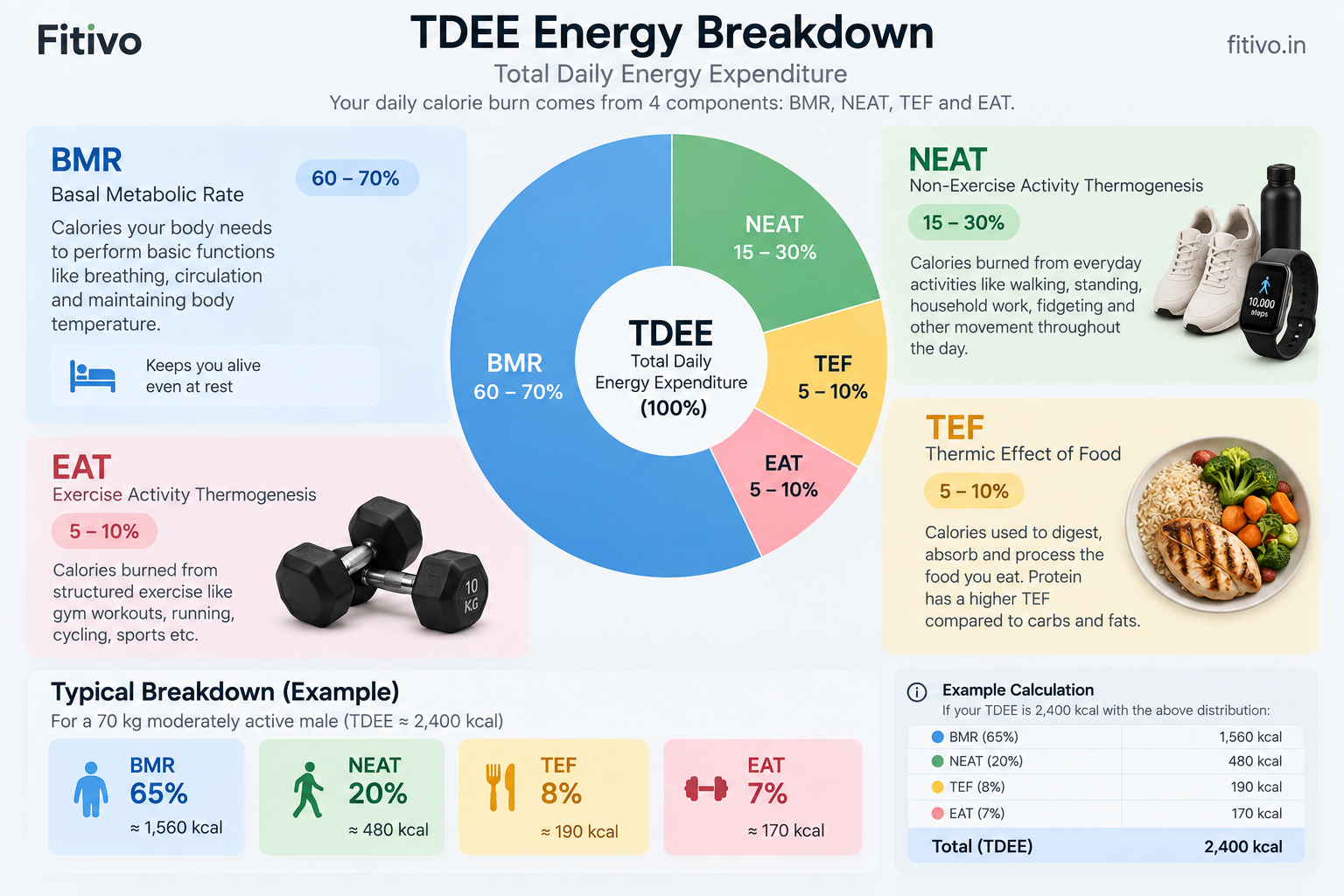
When calculating TDEE, four distinct biological components are evaluated to measure your total energy expenditure:
- Basal Metabolic Rate (BMR): The resting energy required to keep your vital organs operating (comprising 60%–70% of total daily energy expenditure).
- Non-Exercise Activity Thermogenesis (NEAT): Unconscious daily physical movement like walking, typing, standing, and house chores.
- Thermic Effect of Food (TEF): Calories spent digesting and absorbing nutrients (~10% of total daily intake, highest for protein).
- Exercise Energy Expenditure (EEE): Calories expended through structured workouts, resistance training, running, or sports.
How to Calculate TDEE Step-by-Step
To calculate your TDEE manually or through our online TDEE calculator, follow this two-step calculation method:
Step 1 (Calculate BMR via Mifflin-St Jeor):
• Male BMR = (10 × weight in kg) + (6.25 × height in cm) - (5 × age in years) + 5
• Female BMR = (10 × weight in kg) + (6.25 × height in cm) - (5 × age in years) - 161
Step 2 (Apply Physical Activity Factor):
• TDEE = BMR × Activity Multiplier (1.2 for Sedentary to 1.9 for Extra Active)
Once you perform this TDEE calculation, you obtain your maintenance energy requirement. For weight loss, setting your total daily energy intake 300 to 500 calories below your TDEE triggers reliable fat reduction without exhausting your metabolism.
Why Standard Western Calculators Often Overestimate Indian Energy Needs
Many generic international fitness tools use activity definitions tailored to Western work routines. For instance, an office worker in Mumbai, Bengaluru, or Delhi sitting for 8 to 9 hours in an air-conditioned office might select "Moderately Active" because they walk to a metro station or do light domestic chores. In reality, sitting for most of the workday means your true activity factor is Sedentary (1.2x).
Overestimating your activity multiplier leads to an artificially high maintenance calorie target. When combined with traditional Indian staple meals—where wheat rotis, rice, paneer, and cooking oils add up quickly—individuals frequently struggle with unexpected weight gain despite following generic calorie recommendations. The TDEE Calculator India solves this mismatch.
🇮🇳 Calorie & Macronutrient Breakdown of Common Indian Staple Foods
Use these standard reference figures alongside your TDEE Calculator India output to track daily meals accurately:
How the Mifflin-St Jeor Formula Calculates Your BMR
Our TDEE Calculator India relies on the clinical Mifflin-St Jeor equation, recognized globally for superior accuracy across diverse body types:
Male BMR (kcal/day) = (10 × weight in kg) + (6.25 × height in cm) - (5 × age in years) + 5
Female BMR (kcal/day) = (10 × weight in kg) + (6.25 × height in cm) - (5 × age in years) - 161
Once your BMR is established, it is multiplied by your specific physical activity factor to determine your exact daily TDEE maintenance baseline.
Applying Your TDEE Results for Weight Loss or Muscle Building
Once you calculate your maintenance calories using our TDEE Calculator India, apply these evidence-based calorie adjustment guidelines:
- For Moderate Fat Loss (-0.5 kg/week): Subtract 500 calories from your TDEE. This creates a cumulative weekly deficit of 3,500 calories, which equals approximately 0.45 to 0.5 kg of body fat loss.
- For Gentle Weight Loss (-0.25 kg/week): Subtract 250 to 300 calories from your TDEE. Ideal for individuals who want to lose weight slowly without feeling restricted.
- For Lean Muscle Building (+0.25 kg/week): Add 200 to 300 calories to your TDEE while maintaining progressive resistance training in the gym.
Frequently Asked Questions
What is TDEE and how do you calculate it?
TDEE stands for Total Daily Energy Expenditure—the total calories burned in 24 hours. To calculate TDEE, you first find your Basal Metabolic Rate (BMR) using your weight, height, age, and biological gender (via the Mifflin-St Jeor equation), and then multiply it by an activity factor (1.2 to 1.9) representing your daily physical movement.
What is the difference between total energy expenditure and total daily energy intake?
Total Energy Expenditure (TDEE) is the amount of energy your body burns in a day through resting metabolism, digestion, and movement. Total Daily Energy Intake is the total calories you consume from food and beverages. When your daily energy intake equals your total energy expenditure, your body weight stays stable. Consuming less creates a calorie deficit for weight loss.
How do I use this TDEE calculator for weight loss?
To use the TDEE calculator for weight loss, first calculate your daily maintenance calories. Next, subtract 300 to 500 calories from your TDEE result. Consuming 500 calories below your maintenance level creates a cumulative weekly deficit of ~3,500 calories, translating into roughly 0.5 kg of sustainable fat loss per week.
Is there a quick formula for TDEE calculation (TDEE cal)?
A quick rule of thumb (TDEE cal estimate) for sedentary desk workers is body weight in kg multiplied by 28 to 30 kcal. However, for clinical precision, calculating TDEE with the Mifflin-St Jeor formula combined with exact activity multipliers (as done on this page) gives a far more accurate baseline.
Why do standard TDEE calculations need adjustment for India?
Generic calculators often overestimate activity for urban Indian routines. An individual sitting 8–9 hours in an office in Bengaluru or Delhi burns minimal calories even with a short commute. Selecting the 'Sedentary' (1.2x) multiplier ensures your baseline matches real-world energy expenditure and prevents unexpected weight gain.